
Blog's new layout

As you noticed this blog has new layout from today. I hope you like it. I think new layout looks better and more modern than previous one. Please, write you opinion about new layout in comments. If you have some ideas how to make this blog better, all ideas are welcomed.
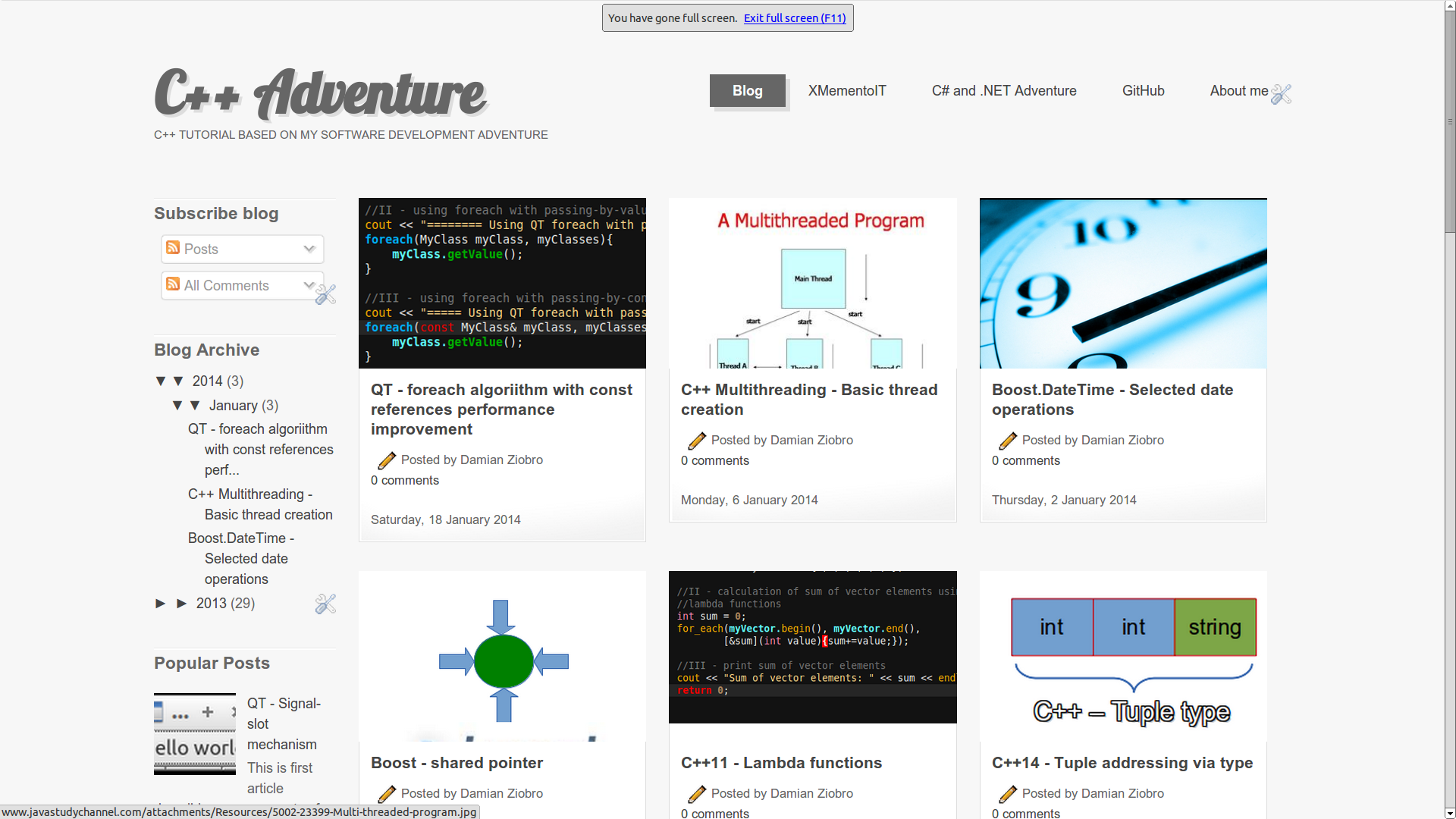


Enjoy new layout and blog articles.

Comments

  1. This new layout is beautiful and definitely looks better than previous one.

    ReplyDelete
  2. Nice change. Blog looks more modern right now.

    ReplyDelete
  3. I like this blog because it presents some advanced aspects of C++ programming one by one. Thanks to that I can bring to my mind programming aspects without reading big books, which is boring.
    Thanks a lot for author and I am looking forward for new articles.

    ReplyDelete

Post a Comment

Popular posts from this blog

Advanced C++ - Stack unwinding

Stack unwinding is normally a concept of removing function entries from call stack (also known as Execution stack, Control stack, Function stack or Run-time stack). Call Stack is a stack data structure that stores active functions' addresses and helps in supporting function call/return mechanism. Every time when a function is called, an entry is made into Call stack which contains the return address of the calling function where the control needs to return after the execution of called function. This entry is called by various names like stack frame , activation frame or activation record. With respect to exception handling , stack Unwinding is a process of linearly searching function call stack to reach exception handler. When an exception occurs, if it is not handled in current function where it is thrown, the function Call Stack is unwound until the control reaches try block and then passes to catch block at the end of try block to handle exception. Also, in this proc...

C++ Multithreading - Race conditions

In the previous C++ Multithreading article I presented you how to pass parameters between threads. Take a detail look on the output of that example once again: In the first line of that output you can notice that output text from two threads is mixed. You are probably wondering why it happens? It is because we are not protecting resources which are shared by two threads (in this example cout stream is shared in both threads) which causes multithreading's phenomenon called race condition . Because threads switching and accessing to shared resources are managed by operating system we do not know when std::cout stream will be accessed by main thread and when it will be accessed by second thread. Therefore in the previous article I mentioned that output of the example can be little different on your computer than my output example. What's more it is possible that this output will be different for few consecutive invoking of the example on the same machine. It is beca...

Advanced C++ - Effective C++ - cheatsheet

I would like to share with you my summary of the "Effective C++" book by Scott Meyers . It is very interesting book for everyone who would like to improve C++ developments skills to be every effective. I highly recommend it. Quick summary of that book, which I prepared you can download after by clicking on below image. Summary of Effective C++ book by Damian Ziobro